
Beneath the Surface
TL;DR
● The S&P 500 finished July up just 0.03%, a flat headline that hid one of the sharpest sector corrections of the year underneath it.
● Semiconductors led the damage: the PHLX Semiconductor Index (SOX) fell as much as 22% intramonth and individual names including SanDisk, Corning, and Marvell dropped 30-40% or more, while the broader Technology sector (XLK) fell as much as 12% before a late-month bounce.
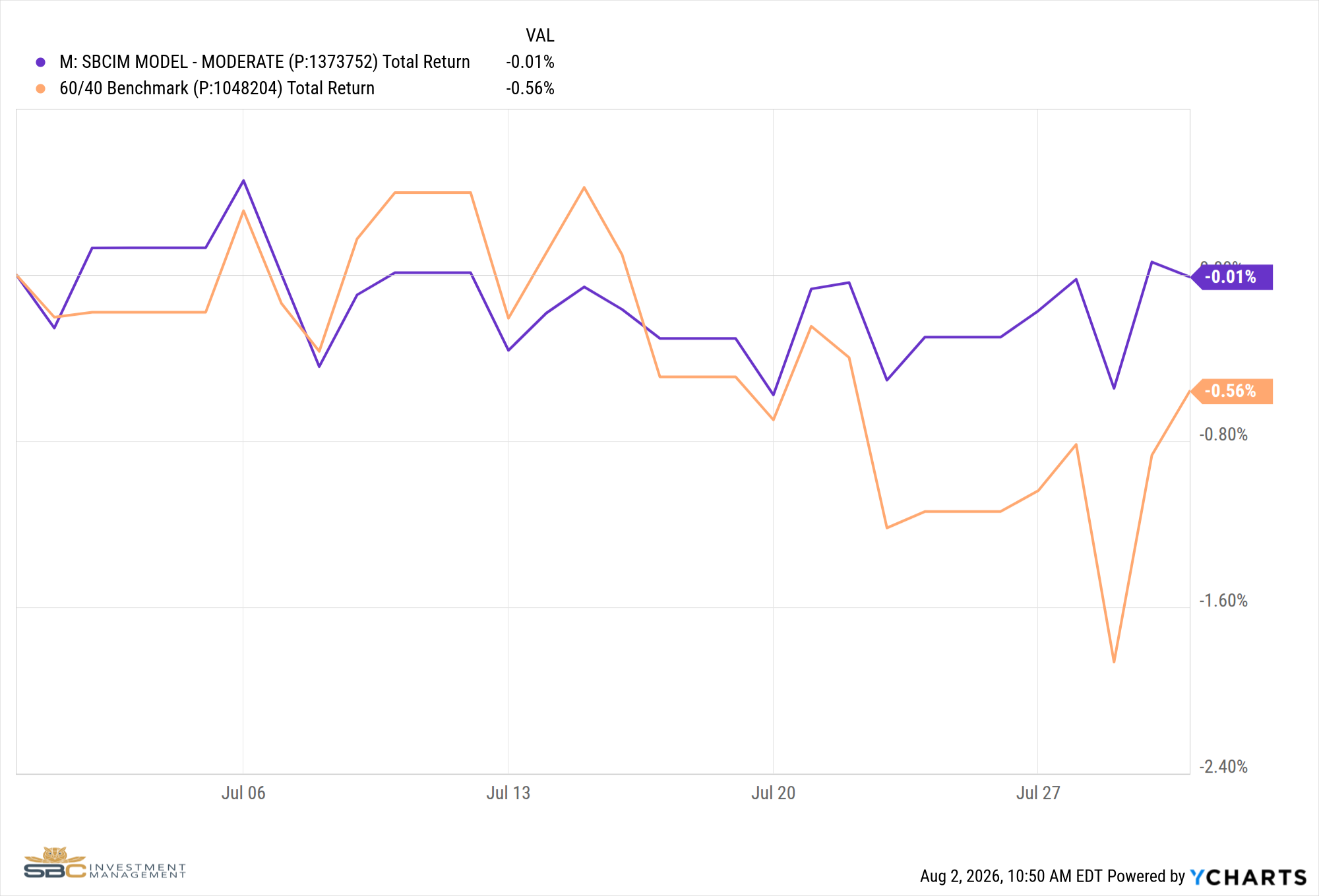
● We began repositioning for this in June, exiting high-beta names including UFO, QTUM, and BUG, raising cash to roughly 8% of the portfolio, and building into Healthcare, Insurance, Real Estate, and Utilities, positioning that helped our Moderate model return -0.01% in July versus the 60/40 benchmark's -0.56%.
● As the selloff stabilized late in the month, we began rebuilding growth exposure, re-adding BUG, and initiating VOOG, and RSP, using cash we had raised ahead of July.
● On a monthly basis, Hedgeye's GIP model shows July and August both printing as growth-deceleration months, but September through December turn constructive, supporting a cautiously constructive stance into year end, tempered by elevated semiconductor volatility and Middle East tensions that can spark with very little warning.
A Flat Headline, A Real Correction
July closed with the S&P 500 up 0.03%, arguably the least informative number that could describe an unusually turbulent month. On paper, a month that ends almost exactly where it started looks uneventful. In practice, July produced one of the widest gaps we have seen in years between what the headline index reported and what most investors actually experienced. Roughly 59% of the index's 500 constituents finished the month higher, and the equal-weighted version of the S&P 500 (RSP) gained about 1.1%, while the cap-weighted index it is built from went nowhere.[1]
That gap exists because a cap-weighted index moves in proportion to a stock's size in the index, not by a simple count of winners and losers. A handful of enormous constituents falling hard can offset broad strength everywhere else, and that is exactly what happened. The technology sector's outsized weight in the S&P 500, more than a third of the index by market value, meant that a sharp drawdown in a relatively narrow group of semiconductor and memory names was large enough to erase the gains of hundreds of other companies at the index level.
Semiconductors Take the Fall
The correction had a clear address. The PHLX Semiconductor Index (SOX), a basket of 30 chipmakers and related suppliers that had roughly doubled over the first six months of the year, fell as much as 22% intramonth before closing July down approximately 18%.[2][4] Individual names were hit even harder over the course of the month: SanDisk, Corning, and Marvell each fell more than 30%, and names including Intel, Micron, KLA, and Western Digital were not far behind.[4] The broader Technology Select Sector SPDR (XLK), which also holds large, more diversified software and mega-cap names, held up better by comparison but still fell as much as 12% by July 29th before a sharp rebound trimmed that loss to roughly 8% by month's end.
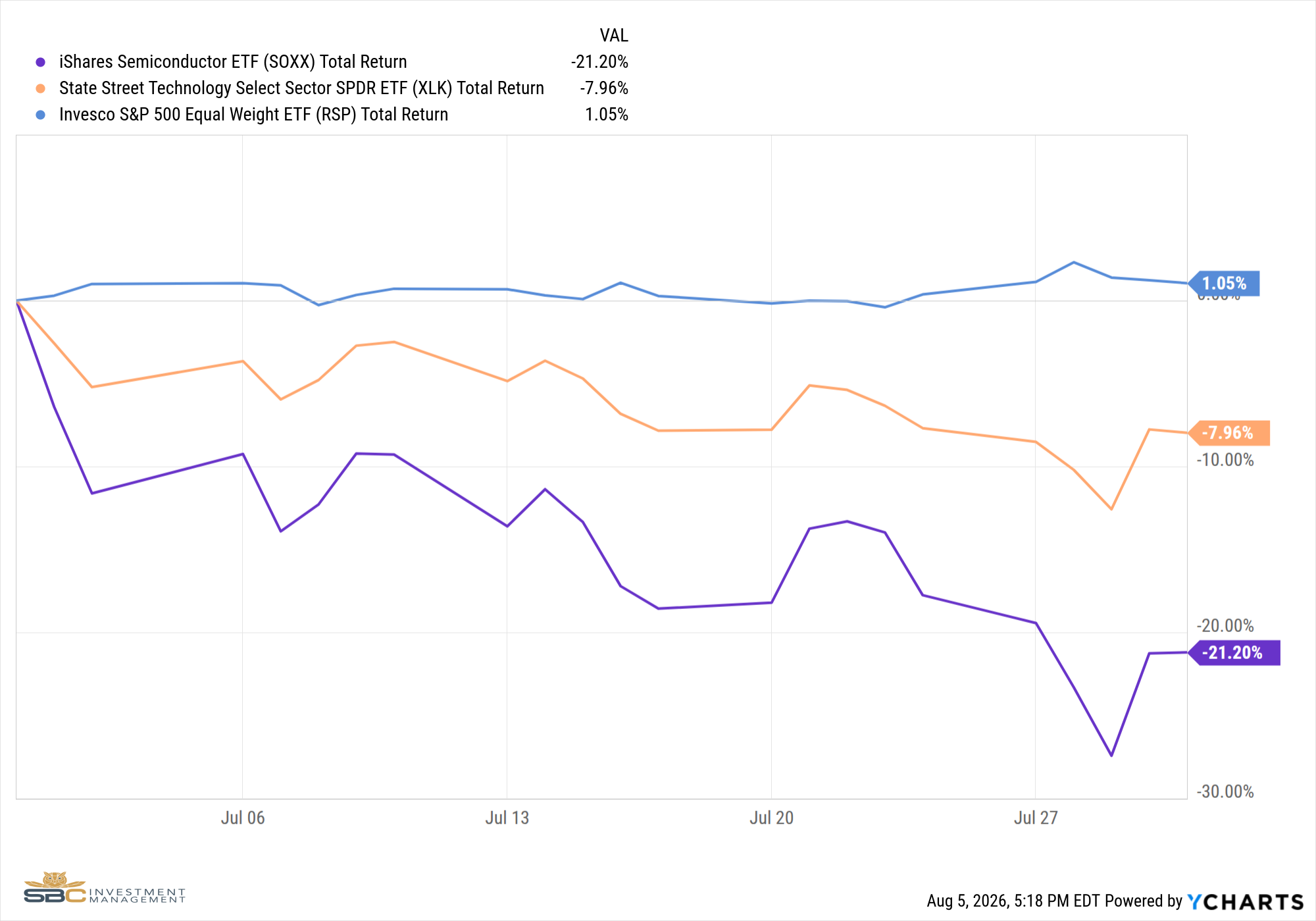
The driving force behind the selloff had less to do with the AI growth story slowing and more to do with how it's being paid for. Through July, investors reassessed how comfortably hyperscalers' enormous AI infrastructure spending is actually being financed, with markets paying far more attention to debt issuance relative to free cash flow than they had earlier in the year.[2] That's a real question about capital structure, not a sentiment shift, and it hit hardest in the memory and equipment names most levered to the buildout.
For most of July, semiconductor weakness was the whole story: chip stocks sold off while the rest of the market, and the equal-weighted index in particular, held up just fine. Thursday, July 30th reversed that pattern completely. Tier1 Alpha's data shows semiconductors alone drove more than 30% of the S&P 500's gain that day, even as more than half of the index's constituents closed lower, marking the third-largest single-day return spread on record between the S&P 500 and its equal-weight counterpart.[2] The only comparable readings on record came in 2000 and 2020, years we don't associate with calm, broadly healthy markets. It's a good reminder of how quickly sentiment in this corner of the market can turn, sometimes within a single session, in either direction.
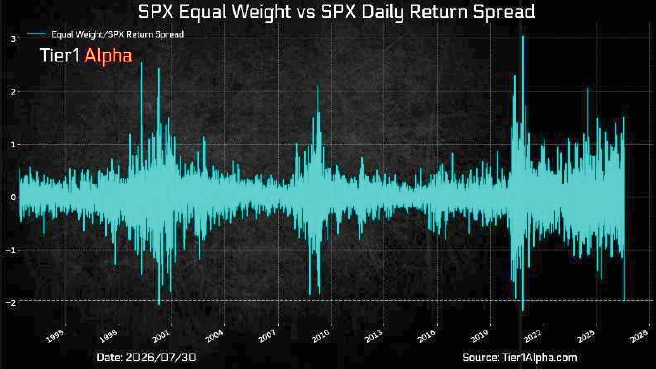
SPX vs. Equal Weight, June 30th Daily Return Spread
How We Positioned Ahead of It
We did not wait for July to arrive before adjusting the portfolio. We had been writing about the potential for this kind of volatility in both our May and June letters, and June's positioning reflected that view directly. On June 17th we added Healthcare (XLV) and Real Estate (XLRE). On June 22nd we added Insurance (IAK), and on June 23rd we added Homebuilders (XHB). On June 29th we sold Quantum Computing (QTUM), Cybersecurity (BUG), Argentina (ARGT), and Small cap Healthcare (PINK), and on June 30th we added Utilities (XLU).
That positioning showed up clearly in July's results. Insurance (IAK) gained 4.70% for the month, Healthcare (XLV) added 2.45%, and Real Estate (XLRE) rose 2.36%, all comfortably ahead of the Technology sector's roughly 8% decline. Not everything from that June build carried its weight, though, and it's worth being honest about why. Utilities (XLU) slipped 2.18%, and on paper it shouldn't have: rate-sensitive assets like Utilities are supposed to work in the disinflation environment we were expecting in July. Instead, Middle East tensions reignited inflation expectations and pushed the long end of the Treasury curve to its highest level since 2007, a headwind entirely outside our control. Aerospace & Defense (XAR) and Homebuilders (XHB) lagged as well and were sold on July 14th and July 21st, respectively, once it was clear they weren't pulling their weight in this environment. That's a nuance worth keeping in mind: not every defensive or rate-sensitive holding worked in July, even as the broader positioning did.
We also moved ahead of the correction on two specific high beta names. Computer Memory (DRAM), added June 10th, was sold July 2nd, just three weeks later and well before memory chips became the epicenter of the selloff; DRAM fell more than 25% in the weeks after we exited. Space Exploration (UFO) was sold earlier on June 10th and has fallen more than 15% since.
Cautiously Re-Engaging Growth
As the semiconductor selloff stabilized and the equal-weight rotation matured, we began rebuilding growth exposure rather than waiting for a full all-clear. On July 14th we added VOOG (S&P 500 Growth) in Satellite 1. On July 21st we added back Cybersecurity (BUG), added a new position in RSP, the equal-weight S&P 500 ETF, and added further to VOOG. These purchases were funded using cash we had raised ahead of July, rather than by selling into other positions.
The RSP addition is worth calling out specifically. Buying the equal-weight index is not a bet on mega-cap technology reasserting itself. If anything, it's closer to the opposite. It is a bet that participation broadens out beyond the handful of names that drove both the run-up through May and the correction in July, which is consistent with the rotation into Financials, Energy, and other cyclical and value-oriented names that accompanied the tech selloff.[1][3] Using cash on hand for both additions kept us from disturbing the defensive positions that are still doing their job.
What We're Watching Into Year-End
On a monthly basis, Hedgeye's GIP model shows July printing as a Quad 4 and August continuing to read as a Quad 3, both consistent with the growth deceleration we've been positioning defensively for. The forecast turns constructive quickly from there: September through December are a mix of Quad1 and Quad2, regimes that have historically favored equities and growth-oriented positioning. It's that shift into the back half of the year, not the current month, that has us scaling back into growth incrementally now rather than waiting for the calendar to turn, while keeping enough defensive exposure in place to bridge the gap.
Two things keep us from leaning in further right now. Semiconductor volatility remains elevated, and after a month like July, we aren't ready to treat that as behind us. It's entirely possible the correction is already over and semiconductors rip back toward the all-time highs they set earlier this year. But at the current level of volatility in that corner of the market, we don't want our portfolios fully exposed to find out either way. The geopolitical situation in the Middle East remains just as unresolved: oil and equity markets have moved sharply on both escalation and de-escalation headlines multiple times since June, including a ceasefire breakdown in early July that pushed crude up 30+%. That kind of risk can spark again with very little warning, something entirely outside our control, and it isn't something we think is safe to price out.
There is however, a supportive backdrop worth keeping in mind too. 2026 is a midterm election year, and midterm years have historically delivered a choppier first half followed by a materially stronger back half: looking at the sixteen most recent midterm cycles, the S&P 500 has rallied an average of roughly 31% over the twelve months following the midterm-year correction, with every one of those cycles finishing positive.[5] We take that history as a tailwind worth respecting, not a guarantee, and it lines up with the Quad framework's own improving forecast for the back half of the year.
We are already adjusting at the margin. In the first days of August, we removed Utilities (XLU) further, responding directly to July's evidence that the rate-sensitive utility trade was underperforming its defensive peers. We will continue to make changes like this as the data comes in, rather than waiting for month-end to act. As always, we remain focused on process over prediction, and we will have more to say on how the Quad 4-to-Quad 1&2 transition is unfolding in next month's letter.
Sources
[1] https://www.ebc.com/forex/why-did-the-s-and-p-500-fall-in-july-2026
[3] https://riskstock.com/article-equal-weight-sp500-record-rotation-july-2026.html
[4] https://finance.yahoo.com/markets/stocks/articles/19-mostly-tech-stocks-fallen-214500420.html
Model Performance Update
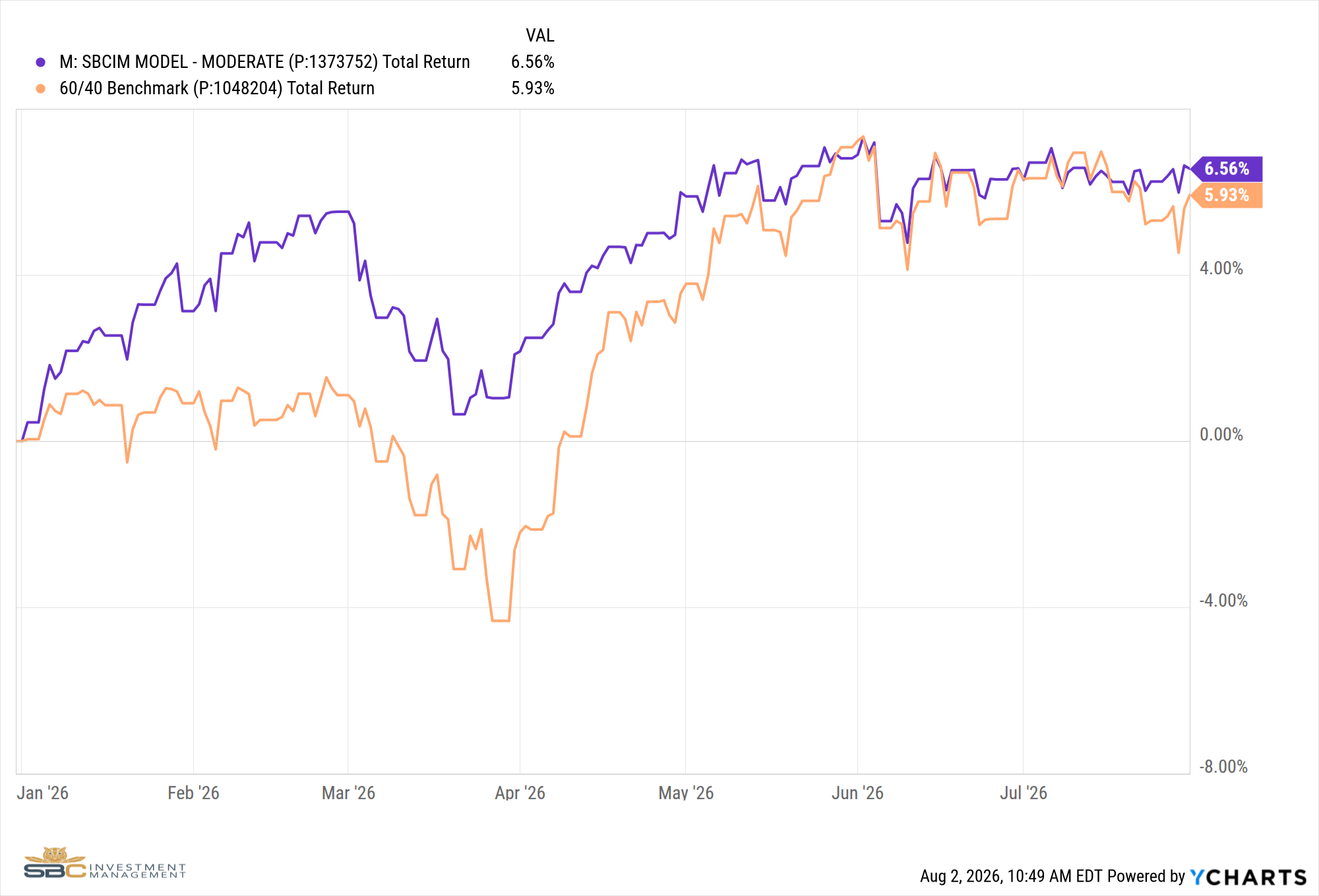
Our Moderate Model Portfolio returned -0.01% in July and has returned +6.56% YTD, versus the 60/40 Benchmark's -0.56% in July and +5.93% YTD.
Portfolio Changes — July 2026
7/1/2026
● Added VCLT (Long Term Corporate Bonds) and ZROZ (Long Term Treasuries) in Satellite 2
7/2/2026
● Sold DRAM (Computer Memory) in Satellite 1
7/9/2026
● Reduced UUP (US Dollar) position by 50% in Satellite 3
7/10/2026
● Sold DBJP (Japan) in Satellite 1
7/14/2026
● Sold XAR (Aerospace and Defense) in Satellite 1
● Added VOOG (S&P Growth) in Satellite 1
7/16/2026
● Sold remaining UUP (US Dollar) position in Satellite 3
7/17/2026
● Sold ZROZ (Long Term Treasuries) and bought BUXX (Enhanced Cash) in Satellite 2
7/21/2026
● Sold XHB (Homebuilders) in Satellite 1
● Bought BUG (Cybersecurity Software) and RSP (Equal Weight S&P) in Satellite 1
● Added to VOOG (S&P Growth) in Satellite 1
July Performance with Benchmark
YTD Performance through July with Benchmark
If you have any questions about the above, please reach out to us to set up a one-to-one meeting so we can review your situation.
Sincerely,
Bryant Andrus, MSF, CFP®
President
SBC Investment Management
P: (602) 641-5996 · M: (319) 520-2033 · E: bandrus@sbcinvestmentmanagement.com
Jake Rehkop
Investment Analyst, Junior Portfolio Manager
SBC Investment Management
P: (435) 775-2950 · M: (435) 590-8317 · E: jrehkop@sbcinvestmentmanagement.com